
Server Training for RL
Server training exposes the training loop as a REST API, enabling external processes to drive gradient updates step by step. This is the primary mode for online RL training.
How Online RL Works with XoRL
Section titled “How Online RL Works with XoRL”Online RL requires a training server, an inference server, and an orchestrator with a reward signal. XoRL provides the first three — you bring the reward.
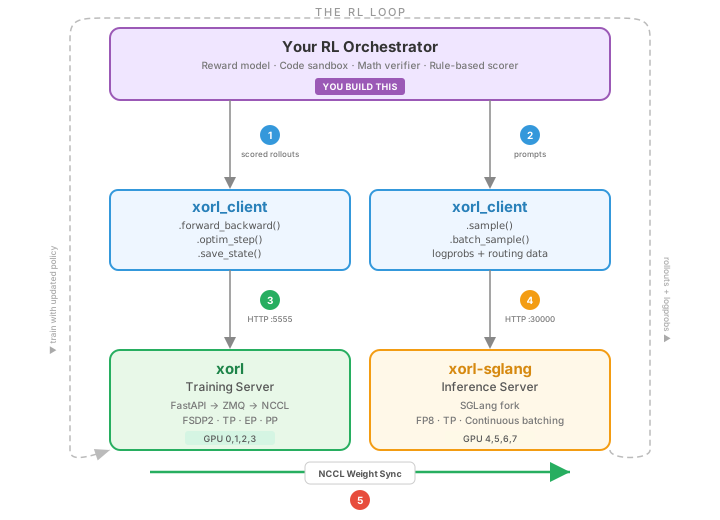
The RL loop:
- Generate rollouts — send prompts to xorl-sglang via
xorl_client.SamplingClient. Returns completions + per-token logprobs. - Score — your reward model / verifier / environment scores the rollouts.
- Train — pack scored rollouts into
Datumobjects, callforward_backward()+optim_step()on the xorl training server. - Sync weights — transfer updated weights to xorl-sglang using the configured NCCL or P2P backend. Cache invalidation follows the request policy and receiver metadata; it is not unconditional. Although XoRL contains a sparse-delta sender, the pinned xorl-sglang revision has no matching receiver.
- Repeat with the updated policy.
| Component | Provided by | Description |
|---|---|---|
| Training server | xorl | Forward/backward, optimizer, checkpointing, parallelism |
| Inference server | xorl-sglang | Rollout generation, per-token logprobs, weight sync |
| Client SDK | xorl-client | Python SDK: TrainingClient, SamplingClient, RestClient |
| Reward / environment | You | Reward model, code sandbox, math verifier, rule-based scorer |
Quick Start
Section titled “Quick Start”1. Start the training server:
CUDA_VISIBLE_DEVICES=0,1,2,3 python -m xorl.server.launcher \ --mode auto \ --config examples/server/configs/full/qwen3_8b_full.yaml \ --api-port 60002. Start xorl-sglang inference:
CUDA_VISIBLE_DEVICES=4 python -m sglang.launch_server \ --model-path Qwen/Qwen3-8B-FP8 \ --port 30000 \ --tp-size 1 \ --rl-on-policy-target xorl \ --enable-fp32-lm-head3. Run training from Python:
import xorl_client
service = xorl_client.ServiceClient(base_url="http://localhost:6000")client = service.create_training_client(base_model="Qwen/Qwen3-8B")
# Register inference endpoint for weight syncimport requestsrequests.post("http://localhost:6000/add_inference_endpoint", json={    "host": "localhost",    "port": 30000,    "worker_port": 30000,    "world_size": 1,})
# RL loopfor step in range(num_steps):    # ... generate rollouts from sglang, compute rewards ...    fwd = client.forward_backward(data, loss_fn="importance_sampling")    opt = client.optim_step(xorl_client.AdamParams(learning_rate=1e-5))    fwd.result(); opt.result()
    if step % sync_interval == 0:        client.sync_inference_weights(            master_address="localhost",            master_port=29600,        ).result()
For multi-node setup, server configuration, and launcher CLI options, see Launching & Configuration.
Available configs
Section titled “Available configs”| Config | Model | Mode | GPUs |
|---|---|---|---|
full/qwen3_8b_full.yaml | Qwen3-8B | Full-weight bf16 | 4 |
lora/qwen3_8b_lora.yaml | Qwen3-8B | LoRA rank 32 | 4 |
qlora/qwen3_8b_qlora_nvfp4.yaml | Qwen3-8B | QLoRA nvfp4 | 4 |
full/qwen3_coder_30b_a3b_full.yaml | Qwen3-Coder-30B-A3B | Full bf16 (SP=4) | 8 |
qlora/qwen3_coder_30b_a3b_qlora.yaml | Qwen3-Coder-30B-A3B | QLoRA (EP=4, SP=4) | 4 |
full/qwen3_235b_a22b_8node_ep64.yaml | Qwen3-235B-A22B | Full bf16 (EP=64) | 64 |
Matching inference models
Section titled “Matching inference models”| Training model | Inference model | TP |
|---|---|---|
Qwen/Qwen3-8B | Qwen/Qwen3-8B-FP8 | 1 |
Qwen/Qwen3-Coder-30B-A3B-Instruct | Qwen/Qwen3-Coder-30B-A3B-Instruct-FP8 | 2 |
Qwen/Qwen3-235B-A22B-Instruct-2507 | Qwen/Qwen3-235B-A22B-Instruct-2507-FP8 | 4 |
xorl-client
Section titled “xorl-client”The xorl-client Python SDK drives the training server — see the Client SDK page for installation, client classes, loss functions, and training loop examples.
Multi-adapter LoRA server training is multi-tenant: each model_id owns a session-specific LoRA and optimizer runtime spec, and non-default sessions can be removed with kill_session. Full-weight server training remains single-tenant and only supports the reserved default session.
Tinker API Compatibility
Section titled “Tinker API Compatibility”Tinker clients can create a usable session with POST /api/v1/create_session. The returned
session_id is registered as xorl’s backing model_id, so follow-up requests may send either
session_id (Tinker-style) or model_id (xorl-native), and the server normalizes both forms.
| Endpoint | Description |
|---|---|
POST /api/v1/create_session | Create/register a Tinker-compatible session ID |
POST /api/v1/session_heartbeat | Refresh a session’s idle timeout |
POST /api/v1/create_model | Create/register a model session with explicit metadata |
POST /api/v1/unload_model | Unload and release a session |
POST /api/v1/forward_backward | Forward + backward pass |
POST /api/v1/optim_step | Optimizer step |
POST /api/v1/weights_info | Checkpoint metadata for model loading |
GET /api/v1/training_runs | List training runs |
Recommended Reading
Section titled “Recommended Reading”XoRL’s server training mode is designed for online RL with LLMs. The following papers provide background on the algorithms and system designs that XoRL supports:
Foundational RL for LLMs
Section titled “Foundational RL for LLMs”| Paper | Description |
|---|---|
| Training language models to follow instructions with human feedback (Ouyang et al., 2022) | InstructGPT — the original RLHF pipeline: SFT → reward model → PPO fine-tuning. Established the standard three-stage approach. |
| DeepSeekMath: Pushing the Limits of Mathematical Reasoning (Shao et al., 2024) | Introduces GRPO (Group Relative Policy Optimization) — a simpler alternative to PPO that uses group-level advantages without a value model. XoRL supports GRPO via loss_fn="importance_sampling". |
| DAPO: An Open-Source LLM Reinforcement Learning System (Yu et al., 2025) | Decoupled clip ratios, dynamic sampling, token-level policy gradient, and overlong reward shaping. Demonstrates RL scaling without a value model. |
| ReMax: A Simple, Effective, and Efficient Method for Aligning LLMs (Li et al., 2023) | REINFORCE with a max-reward baseline — no critic needed. Shows that simpler RL methods can match PPO performance with less compute. |
System Design: Pipelining and Async RL
Section titled “System Design: Pipelining and Async RL”| Paper | Description |
|---|---|
| Asynchronous RLHF: Faster and More Efficient Off-Policy RL for Language Models (Noukhovitch et al., 2024) | Decouples generation and training into async processes. Shows that off-policy RL (training on stale rollouts) works well with proper importance correction — the motivation behind XoRL’s TIS (Temporal Importance Sampling). |
| INTELLECT-2: A Reasoning Model Trained Through Globally-Distributed Reinforcement Learning (Primeintellect, 2025) | Distributed async RL training across globally distributed nodes. Demonstrates that RL training can scale across unreliable, heterogeneous clusters. |
| OpenRLHF: An Easy-to-use, Scalable and High-performance RLHF Framework (Hu et al., 2024) | Ray-based RLHF framework with vLLM integration. Demonstrates the separation of training and inference into distinct processes — the same architecture XoRL uses. |
| verl: Volcano Engine Reinforcement Learning for LLMs (Sheng et al., 2024) | Hybrid pipeline that colocates actor and rollout on the same GPUs with memory sharing. Shows how to minimize GPU idle time in the RL loop. |
Techniques Supported by XoRL
Section titled “Techniques Supported by XoRL”| Paper | XoRL feature |
|---|---|
| GLM-5: Open Multilingual Multitask Model (Team GLM, 2025) | IcePop — hard gradient masking for extreme importance ratios. Available via icepop_beta parameter in policy_loss. |
| LoRA: Low-Rank Adaptation of LLMs (Hu et al., 2021) | LoRA and multi-adapter support. XoRL supports multiple concurrent LoRA adapters switchable per request. |
| QLoRA: Efficient Finetuning of Quantized LLMs (Dettmers et al., 2023) | QLoRA training with nvfp4, block_fp8, and nf4 quantization formats. |
Further Reading
Section titled “Further Reading”| Topic | Page |
|---|---|
| Server architecture, multi-node, launcher CLI | Launching & Configuration |
| REST API endpoints | API Reference |
| xorl-sglang: weight sync, numerical alignment | Inference: xorl-sglang |
| Client SDK, loss functions, training patterns | Client SDK (xorl-client) |
| NCCL weight sync protocol | Weight Sync |
| SFT fine-tuning example | SFT on No Robots |
| End-to-end weight sync test | Password Memorization |